

The words that do not exist
Hermeneutical injustice, or what happens when the word you need exists in no language you could switch to.

Subscription is free with an option to support my work with a paid low cost monthly or yearly subcription.
Alternatively, you can also
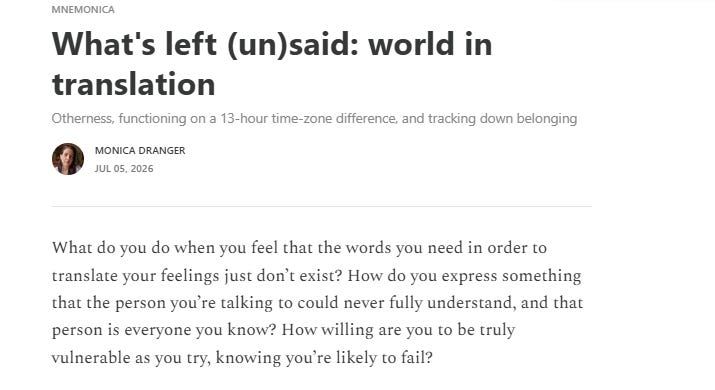
I owe the idea for this article to Monica Dranger. Reading her essay on bilingualism and belonging, I recognised in her opening questions another form of the epistemic injustice I examined in my two previous pieces (Who gets believed and Free to speak, unable to be heard). This time it takes the form of hermeneutical injustice.


Dranger opens her essay “What’s left (un)said: world in translation” with three questions: “What do you do when you feel that the words you need in order to translate your feelings just don’t exist? How do you express something that the person you’re talking to could never fully understand, and that person is everyone you know? How willing are you to be truly vulnerable as you try, knowing you’re likely to fail?”
In her piece the questions are about bilingualism, about reaching for a word that lives in one of your languages while you are speaking the other. We exchanged messages, and, as she put it herself, the questions illustrate problems larger than her own experience, beyond bilingualism. I use these questions as a starting point for experiences beyond bilingualism and analyses them with tools from linguistics and philosophy of language, begining with the case in which the word you need exists in no language you could switch to.
Each question identifies a different pressure point. The first concerns the interpretive resources available to a speaker. The second concerns whether a hearer can recognise the experience being described. The third concerns the cost of speaking when recognition is unlikely. Social epistemology gives a name to one important pattern connecting them: hermeneutical injustice. This article asks what the concept explains, where its limits lie, and why those limits matter. This article, the third in my series on epistemic injustice, examines what the concept explains, where its limits lie, and why those limits matter.
A word arrives thirty years late
In 1975, Carmita Wood resigned from her job at Cornell University after a senior colleague subjected her to persistent unwanted sexual advances. She had developed physical symptoms of stress and had requested a transfer without success. When she applied for unemployment benefits, the form asked why she had left. She could not say. Her claim was rejected on the ground that she had left for “personal reasons”, which sounded trivial and self-inflicted. Her case prompted women at Cornell to compare similar experiences and develop a name for the pattern: sexual harassment. Susan Brownmiller (1999) records the episode in her memoir of the movement, and Miranda Fricker (2007) opens her account of hermeneutical injustice with it.
Fricker’s central definition is precise (2007, p. 155): hermeneutical injustice occurs when a gap in the shared interpretive resources obscures people’s own social experience from collective understanding, and the gap exists because their social group participates unequally in the practices through which public meanings get made (2007, p. 153). Wood lacked neither intelligence nor fluency. She lacked a public concept, and she lacked it because women had played too little part in shaping the public vocabulary of workplace experience.
Let us be clear as to where the deficit sits. The deficit does not lie in the speaker. It lies in the shared interpretive resources available to her, and in the unequal social practices through which those resources are formed. The problem is not simply that a dictionary lacks a word. A society may lack a concept, a framework or an accepted way of connecting events that are otherwise treated as isolated. It is like a library whose catalogue contains no category under which the relevant experiences can be brought together.
When the words exist and still fail
The second question moves the problem from the dictionary to the hearer. “The person you’re talking to could never fully understand, and that person is everyone you know.” A speaker who assembles adequate words can still fail if no hearer possesses the frame to receive them. I examined this mechanism in my article on uptake, drawing on J.L. Austin. Many illocutionary acts depend on uptake: the hearer must recognise the force of what is said. A hermeneutical gap can help explain why that recognition repeatedly fails. The concept need not be absent everywhere. It may exist within a marginalised community while remaining unavailable, unintelligible or unacceptable within dominant institutions.

Fricker adds an asymmetry worth keeping in view. The hearer who fails to understand merely misses information. The speaker loses something graver: part of her capacity to render her own life intelligible, to others and, over time, to herself.
Is every unspeakable feeling an injustice?
My answer is no. Some experiences (grief, chronic pain, the smell of coffee) resist description because language is always incomplete. That alone is not hermeneutical injustice. The better test is not simply who lacks the words, since an entire society may lack a concept. Ask instead who bears the cost of the gap, whose experience it obscures, and whether unequal participation in meaning-making helped produce it. When the disadvantage tracks a marginalised social position, the problem may be an injustice rather than a general limit of expression.
Coercive control shows the test working. For decades, victims described the pattern piecemeal: monitored phones, controlled money, engineered isolation, rules about clothing. Police files recorded “no violence”. Each incident, described alone, sounded minor. Evan Stark (2007) developed the concept of coercive control as a continuing pattern of domination rather than a series of isolated incidents. Section 76 of the Serious Crime Act 2015 subsequently created an offence of controlling or coercive behaviour in an intimate or family relationship in England and Wales.The experience had always existed. The conduct had long existed, but the concept made its cumulative pattern more visible to victims, researchers and institutions.
I return now to Dranger’s first question, extended beyond its original bilingual frame: what do you do when “the words you need in order to translate your feelings just don’t exist”? Nothing in the question, taken alone, tells you which kind of gap this is. If it is the kind everyone faces, the situation is tragic: language runs out. If the gap tracks who the speaker is, it is political: the vocabulary was built without them. No one can tell from the words alone. That is part of the harm. A gap of this kind conceals its own cause: you cannot tell if language has failed everyone or excluded you in particular. The two difficulties can also combine. An emotion may resist exact description for any speaker, while a man taught that emotional language is not for him faces an additional, socially patterned restriction. The expressive difficulty may be shared; the disadvantage is not. The gap is shared; the disadvantage is not (Fricker, 2007).
The price of trying
The third question asks about vulnerability in the face of expected failure. Kristie Dotson (2011) names one response to that vulnerability: testimonial smothering, in which a speaker restricts her testimony because she judges her audience unable or unwilling to receive it competently. Smothering can be a rational response to an epistemically unsafe audience. Why offer the most exposed version of yourself to a hearer likely to misunderstand or dismiss it? The third question captures the moment before smothering, when the speaker calculates the likely cost of disclosure. Anyone who has rehearsed an explanation and then said something smaller knows that calculation. Here the three problems can intersect: testimony is reduced because uptake is expected to fail, sometimes because the audience lacks the interpretive resources needed to understand it.
Do words translate feelings, or partly make them?
One assumption in the quotation needs qualification. It speaks of translating feelings as though an experience sat fully formed in the mind, waiting for linguistic clothing. Wittgenstein challenges the related picture of inner states as private objects whose names acquire meaning through an act of inward pointing. Barrett makes a different, empirical claim: emotion concepts help the brain categorise bodily sensations and construct emotional experience. On Barrett’s account, learning a label such as hangry may help speakers distinguish and organise a state they had previously experienced less precisely. The word helped them individuate a state they had previously experienced as undifferentiated bad temper.

If that is right, hermeneutical gaps do worse than block expression. They may stop part of the experience from taking shape at all. That raises the stakes of Fricker’s argument considerably. The library with the missing shelf does not merely frustrate its readers; it may also change how readily they can identify, organise and understand their experience.
Repairing the shelf
Communities do repair these gaps. Consciousness-raising groups developed sexual harassment. Campaigners and researchers established coercive control as a name for a continuing pattern of domination. Naming/coining can be a political act: a new expression can gather scattered experiences into a public category. The next article steps back from the framework to its author, Miranda Fricker, and to how one book created a field. After that comes José Medina, who asks who gets to do the coining, and whose epistemology of resistance examines the interpretive tools marginalised groups build when the mainstream refuses to build them.
COINING IS A POLITICAL ACT PERFORMED WITH MORPHOLOGY
©Antoine Decressac 2026
Subscription is free with an option to support my work with a paid low cost monthly or yearly subcription.
Alternatively, you can also
Barrett, L.F. (2017) How emotions are made: the secret life of the brain. London: Macmillan.
Brownmiller, S. (1999) In our time: memoir of a revolution. New York: Dial Press.
Dotson, K. (2011) ‘Tracking epistemic violence, tracking practices of silencing’, Hypatia, 26(2), pp. 236-257.
Fricker, M. (2007) Epistemic injustice: power and the ethics of knowing. Oxford: Oxford University Press.
Medina, J. (2013) The epistemology of resistance: gender and racial oppression, epistemic injustice, and resistant imaginations. Oxford: Oxford University Press.
Stark, E. (2007) Coercive control: how men entrap women in personal life. Oxford: Oxford University Press.
Wittgenstein, L. (1953) Philosophical investigations. Translated by G.E.M. Anscombe. Oxford: Blackwell.