

Who gets believed
How language decides which voices carry weight

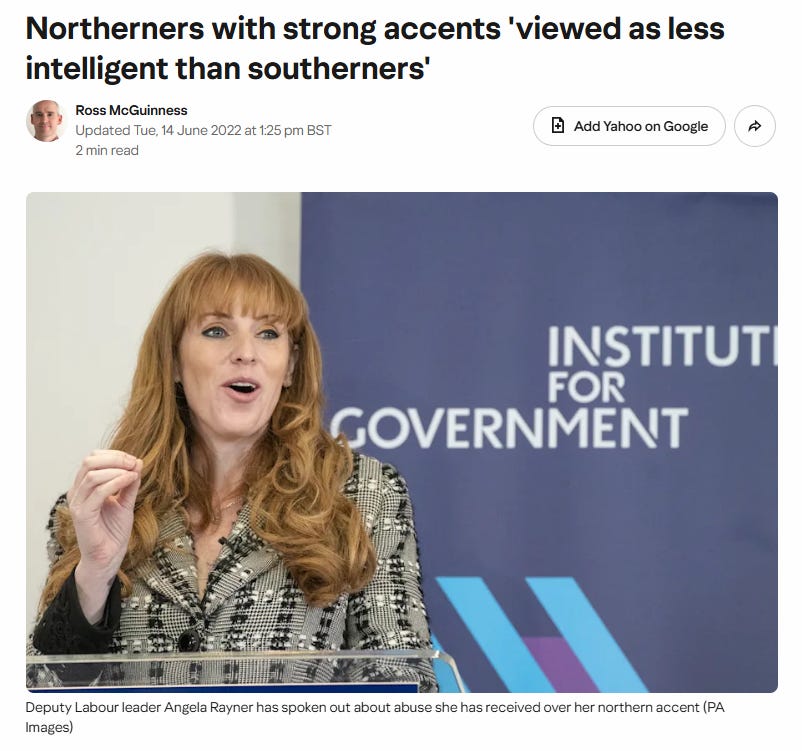
This is a reaction piece to conversations I have heard, twitter posts I have seen or titktoks I have watched (yes… I know!).
My articles are free for everyone to read, engage with and share with others
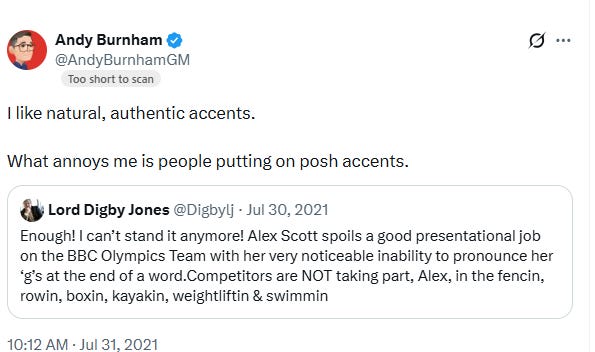
Say a sensible thing in the wrong accent and watch it sink. You might take that for a relic of the age of BBC Received Pronunciation, now that regional voices read the national news. The evidence says otherwise. In 2021, a representative sample of the British public rated thirty-eight accents for prestige, and the ranking had barely moved since the 1970s. The old prestige accents still sat at the top, and urban working-class and several ethnic-minority accents still sat at the bottom (Levon , Sharma, Watt, Cardoso, and Ye: 2021). The voices on air have diversified. The judgements behind the ear have not.
The bias can affect real decisions. When a representative sample judged mock candidates for a trainee solicitor post, accent moved their ratings of competence and hirability. I have a French accent after forty years in Britain, and I notice the same point can carry differently from one room to the next, in ways the argument alone does not explain. This piece is about the machinery behind that: how speech cues decide who gets believed, before anyone evaluates the actual claim.

A name for the problem
The philosopher Miranda Fricker gave the pattern a name. In Epistemic Injustice (2007), written while she was a Reader in Philosophy at Birkbeck, she calls it testimonial injustice. It occurs when prejudice leads a hearer to assign the speaker “a deflated level of credibility”. Her central case is straightforward. A police officer disbelieves a Black witness because of racial prejudice, before the testimony is assessed at all. The doubt falls on the speaker, not on what he said.
Fricker’s pair of terms are useful here. Some speakers receive a credibility deficit: they are believed less than they deserve. Others enjoy a credibility excess: they are believed more than they have earned. The same claim, moved from one mouth to another, changes value.
So far, Fricker's account belongs to ethics and epistemology. It explains that prejudice lowers credibility, but it says less about which cues set the prejudice off. That is the linguistic question, and the answer is often speech itself.
The cue is in the voice
Accent, dialect and register are among the fastest social signals we produce. A few seconds of talk place a person by class, region, ethnicity and schooling. Those placements then feed the credibility judgement.
The evidence is old and robust. In 1960, Wallace Lambert and colleagues ran what became known as the matched-guise test. Bilingual speakers in Montreal recorded the same passage twice, once in English and once in French. Listeners, told they were judging different people, rated the English voices higher on traits such as intelligence and ambition. The French-speaking listeners did the same to their own language (Lambert et al. 1960). Same speaker, same words, different verdict.
Howard Giles found similar effects for accents inside a single language. Prestige accents draw higher ratings for competence and status (Giles 1970). Accent marks where a speaker comes from, not how well they think. Even so, the acccent is read as a sign of the mind behind it.
The standard as inherited credibility
Why does one way of speaking carry authority and another carry suspicion? Pierre Bourdieu’s answer is that a society installs a “legitimate language”, a standard treated as correct and educated, then hands it out unequally. Command of that standard is a form of capital, what he calls linguistic capital (Bourdieu 1991). Those raised inside it inherit credibility. Those outside it have to acquire it, and pay a tax of suspicion until they do.

Bourdieu calls the result symbolic violence: domination that the dominated half accept as natural, because the ranking of speech looks like a ranking of merit. Rosina Lippi-Green gives the belief behind it a name, the standard language ideology: the assumption that one idealised, uniform variety is the only correct form, propped up by powerful institutions, with every other way of speaking marked as a lapse (Lippi-Green 1997). James and Lesley Milroy show how that standard is enforced, through what they call the complaint tradition, the long habit of publicly scolding ordinary usage as error (Milroy and Milroy 1985). Under this ideology, a regional or working-class voice begins every exchange a step down.
Scaling up: whole languages
The same categorisations runs at the level of entire languages. Colonial rule seized land and labour. It also ranked tongues, and through them, minds.
In Decolonising the Mind (1981), Ngũgĩ wa Thiong’o argues that empire used schooling to demote African languages and install European ones as the measure of intelligence. “Language was the means of the spiritual subjugation,” he writes. Children were punished for speaking their mother tongue. The lesson they absorbed was that knowledge wore a European accent.
Robert Phillipson named the modern continuation linguistic imperialism: the structural dominance of a few languages, English above all, across science, education and global institutions (Phillipson 1992). When so few languages carry institutional authority, speakers of the rest begin at a credibility deficit in the places that confer it: journals, universities, courts and international bodies. This is the colonial knowledge order, and its mechanism is linguistic.
Discrediting the experts
However, the same tool can be aimed upward. Populist politics has learned to manufacture a credibility deficit for experts.
The method is lexical. A scientist becomes a member of “the elite”. A university becomes an “ivory tower”. Guidance becomes the work of “so-called experts”, to be answered with the instruction to “do your own research”. Each phrase performs the move Fricker described, run in reverse. It fixes a discrediting label to a social type, so the audience discounts the testimony before considering it.
Antonio Gramsci saw this mechanism early. He set organised knowledge against “common sense”, the inherited stock of everyday assumptions, and noted that an appeal to common sense can defeat expertise by making a contested claim feel obvious (Gramsci 1971). Anti-expert rhetoric runs on exactly this. It dresses a position as plain good sense and recasts the specialist as a remote, self-serving caste.

Two fights that look alike
It is tempting to file the decolonial critique and the populist revolt together. Both attack the idea that the certified speaker is automatically right. Both say credibility has been rigged. The resemblance may be real, but it is misleading.
The difference is in the aim. The decolonial critique wants to widen the circle of credible voices. It asks for more evidence, and for the knowers and knowledges the colonial order discounted. Populist anti-expertise wants the opposite: to collapse the idea that one claim can be better founded than another, so that the loudest voice wins by default. One enlarges the franchise of knowledge. The other abolishes the currency. Treating the two as the same is itself a rhetorical tactic, convenient for anyone who profits from the confusion. The linguist's task is to keep them apart.
Next
Credibility, then, is partly an effect of phonetics and word choice. We assign it in seconds, by ear, and dress the result as judgement. Knowing this will not switch the reflex off. It can make us slower to trust the verdict our ears deliver, and quicker to ask what the speaker actually said.
Fricker (2007) described a second kind of epistemic injustice, one that can bite harder: hermeneutical injustice, where a group lacks the very words to name what is being done to it. That is the subject of the next post.
© Antoine Decressac 2026
My articles are free for everyone to read, engage with and share with others
you can opt to susbcribe for less that £1 ($1.30$) a month or £7 ($9.30) for the year. The free option is still available.
Bourdieu, P. (1991) Language and Symbolic Power. Cambridge: Polity.
Fricker, M. (2007) Epistemic Injustice: Power and the Ethics of Knowing. Oxford: Oxford University Press.
Giles, H. (1970) ‘Evaluative reactions to accents’, Educational Review, 22(3), pp. 211–227.
Gramsci, A. (1971) Selections from the Prison Notebooks. London: Lawrence and Wishart.
Lambert, W.E., Hodgson, R.C., Gardner, R.C. and Fillenbaum, S. (1960) ‘Evaluational reactions to spoken languages’, Journal of Abnormal and Social Psychology, 60(1), pp. 44–51.
Levon, E., Sharma, D., Watt, D.J.L., Cardoso, A. and Ye, Y. (2021) ‘Accent bias and perceptions of professional competence in England’, Journal of English Linguistics, 49(4).
Lippi-Green, R. (1997) English with an Accent: Language, Ideology, and Discrimination in the United States. London: Routledge.
Milroy, J. and Milroy, L. (1985) Authority in Language: Investigating Language Prescription and Standardisation. London: Routledge and Kegan Paul.
Ngũgĩ wa Thiong’o (1981) Decolonising the Mind: The Politics of Language in African Literature. Zimbabwe Publishing House (Pvt.) Ltd (1987)
Phillipson, R. (1992) Linguistic Imperialism. Oxford: Oxford University Press.
Sharma, D., Levon, E. and Ye, Y. (2022) ‘50 years of British accent bias: Stability and lifespan change in attitudes to accents’, English World-Wide, 43(2).