

Antonio Gramsci: How Language Makes Power Feel Like Common Sense
Why political language often works best when it stops sounding political

All my articles are available for free, if you want to support my work you can
There is a sentence you have probably heard recently; it has appeared across UK party-political discourse, from New Labour’s vocabulary of working families to later Conservative appeals to hard work, responsibility and aspiration. It goes along the lies of: “We stand with hard-working families.”
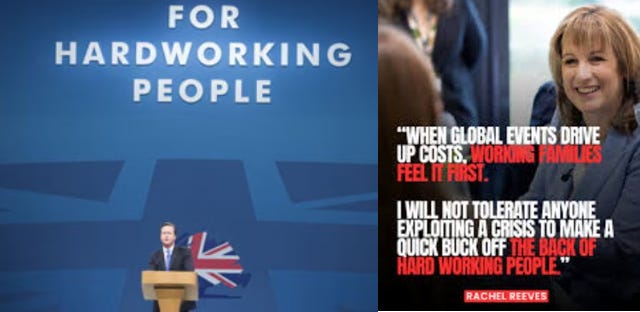
It sounds reasonable. It sounds fair. It sounds, in many ways, obvious. That sense of obviousness is exactly what Antonio Gramsci spent his career trying to explain.
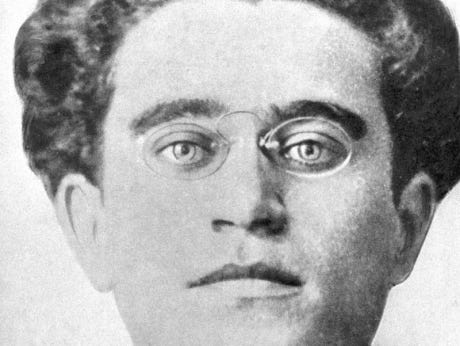
Gramsci (1891–1937) was an Italian Marxist philosopher, politician, who has studied linguistics formally at the University of Turin and who died in fascist captivity. Between 1929 and 1935, imprisoned on Mussolini’s orders, he filled thirty-three notebooks with political theory, historical analysis, and close attention to language. Selections from the notebooks were published posthumously (Prison Notebooks, 1947 (Italian, 1957 for teh first English translation1) and have since become foundational texts in critical theory, cultural studies, and discourse analysis. Their central question is deceptively simple: how does a ruling class maintain its position without constant recourse to force?
The answer is hegemony. And hegemony works, in large part, through language.
What hegemony is not
Hegemony is frequently reduced to a synonym for dominance or ideology, which misses what Gramsci was arguing. For Gramsci, hegemony is not simply the imposition of one group’s will on another. It is the process by which a dominant group’s worldview becomes the worldview: the background against which all other positions are judged. It operates through consent rather than coercion, through culture rather than law, and through the categories we use to make sense of the world rather than the content of any single argument.
Gramsci developed this argument from a specific political defeat. The revolutionary wave that followed the First World War failed across Western Europe, while fascism succeeded in Italy. Gramsci's analysis of that failure shaped everything in the notebooks. His conclusion was that in advanced capitalist societies, political power cannot simply be seized. It must first be prepared for, through a prolonged "war of position": the gradual building of intellectual and cultural authority in civil society, in schools, newspapers, professional associations, and political vocabulary, before the question of state power is even reached. Hegemony is not the prize awarded to whoever wins political power. Hegemony is the precondition for winning it.*
The mechanism Gramsci identified is what he called “common sense” (senso comune). This requires some care. In everyday usage, common sense means practical wisdom, the obvious thing to do. In Gramsci’s analysis, it refers to the accumulated, uncritical body of assumptions and categories that most people in a given society hold without examining. Common sense is ideologically saturated, but not mechanically imposed. It is not usually designed in a deliberate or centralised way. It forms over time, through years of circulating ideas, repeated phrases, institutional habits, media categories and political vocabularies. These shape what a society comes to treat as reasonable, natural or self-evident. Common sense is therefore mixed and uneven. Some of it supports dominant interests; some of it contains the beginnings of resistance.
The key word is “natural.” When a political position feels like common sense, it feels like a description of reality rather than an argument about it. That naturalisation is the achievement of hegemony.
Language as the site of struggle
Gramsci was not using language metaphorically when he wrote about power. He had studied linguistics formally at the University of Turin under Matteo Bartoli, a specialist in how language varieties gain and lose social prestige. Bartoli argued that linguistic change is driven less by internal grammatical evolution than by the social standing of the groups who use particular forms. Gramsci absorbed this lesson: language is never a neutral instrument. It is always already shaped by social relations, and it in turn reproduces them.
This means that the vocabulary available for political debate is itself a political achievement. Who controls the terms of a debate influences, in advance, what conclusions are reachable within it.
Consider “hard-working families,” a phrase with a long life in UK political discourse across both main parties. The phrase sounds inclusive. In fact, it operates through exclusion. The deserving social actor it constructs is defined by paid, conventional labour and by membership of a family unit. Those outside these categories, the unemployed, the disabled, single adults, those in non-traditional households, are not addressed by the phrase. They do not appear within it. The phrase does not argue that these groups matter less. It simply constructs a political subject that does not include them, and then presents that construction as a description of who “working people” are.
Gramsci would call this a hegemonic move. The phrase does not describe a social group. It constructs one, while the construction disappears inside the apparent description.
The household metaphor in fiscal policy
A parallel analysis applies to “fiscal responsibility.” The phrase frames government finance through the analogy of household budgeting: a responsible household does not spend beyond its means; neither should a responsible government. The analogy is politically productive because it is linguistically prior to the debate. To question austerity within this framework is to position oneself as an advocate for irresponsibility. The debate has been partly settled at the level of vocabulary before the argument begins.
Whether governments should run surpluses or deficits is an economic question, and this article takes no position on it. The linguistic question is different: how does the phrase “fiscal responsibility” frame that debate before it begins? The point is that the phrase encodes a particular position, the household analogy, as if it were a neutral descriptive standard. That encoding is a Gramscian operation. Whoever establishes the metaphor through which economic policy is discussed has already shaped the terrain on which arguments will be made.
This is what Gramsci meant by saying that the struggle over language is inseparable from the struggle over politics.
The organic intellectual
Gramsci distinguished between two types of intellectual. “Traditional intellectuals” present themselves as above politics: the expert, the independent analyst, the technocrat. “Organic intellectuals” are embedded in a social class and articulate its worldview, not necessarily with any conscious agenda, but by working within conceptual frameworks they have not questioned. A journalist who uses “fiscal responsibility” as a neutral descriptor, or a think-tank economist who treats the household analogy as self-evident, may function as an organic intellectual of a particular ideological order.
This claim is not about bad faith. Gramsci was not interested in identifying villains. He was interested in the structural conditions that make certain ideas feel natural and others feel extreme.
This is also why Gramsci paid close attention to the institutions through which ideas circulate: schools, the Church, the press, and, in the 1930s, radio. These were not neutral channels. They were the terrain of the war of position. Whoever controls the dominant media controls, to a significant degree, which frameworks become available for making sense of political life and which remain marginal. Gramsci called this the struggle for the "national-popular": the contest over which ideas come to feel like the common property of a whole society rather than the interest of a particular group. The linguistic techniques this article has examined, the framing of social actors, the naturalisation of economic metaphors, do not operate in isolation. They are produced and reproduced through institutions that are themselves sites of political contest.*
A necessary qualification
Hegemony is not totalising. Gramsci’s account has sometimes been read as implying that dominant ideologies achieve complete control over how people think. That is too strong a reading. Gramsci himself distinguished between “common sense” and “good sense” (buon senso): the latter is the critical, reflective capacity that exists within ordinary thought and can, under the right conditions, come to recognise and resist hegemonic assumptions. Counter-readings, oppositional frameworks, and resistant uses of language are always possible. Stuart Hall’s later work on encoding and decoding makes this explicit, and it will be the subject of the next article in this series.
Gramsci and critical discourse analysis
Norman Fairclough, whose work on language and power has shaped critical discourse analysis since the 1980s, drew explicitly on Gramsci. For Fairclough, discourse is a form of social practice: it reproduces social relations, but it can also contest and transform them (Fairclough, 1992, p. 63). The Gramscian inheritance is direct. Without the concept of hegemony, CDA has a method for identifying linguistic features but lacks a political theory to explain why they exist, how they are sustained, and whose interests they serve.
Asking what a text naturalises, what it presents as obvious rather than argued, what positions it makes sayable and what it renders unsayable: these are Gramscian questions. They are also the practical questions of applied discourse analysis.
Why the vocabulary matters
Gramsci died in 1937. He did not live to see the political vocabularies of Thatcherism, the Third Way, or post-2008 austerity. But his framework explains how those vocabularies worked: how “there is no alternative” functioned not as an argument but as a boundary around what could be thought; how “the market” came to feel like a force of nature rather than a political arrangement; how “reform” came to mean, consistently, reduction rather than change.
Gramsci described hegemony with great precision. He did not, however, give a method for seeing it in any particular text. Common sense feels natural. The dominant vocabulary feels neutral. The assumptions of the powerful pass as ordinary observations about the world. How does this work, at the level of who speaks, who is heard, and whose definitions stick? Gramsci left those questions open.
In the next article, I will discuss Pierre Bourdieu, who gives one of the most useful answers to these questions. Bourdieu argued that every utterance is an exchange on a linguistic market, that some speakers hold more symbolic capital than others, and that the language of the state and the school has been imposed as the legitimate currency. Where Gramsci gives us hegemony as common sense, Bourdieu gives us hegemony as the unequal economy of speaking. The two thinkers belong together. Bourdieu is also the methodological bridge from this strand of political theory to the applied analyses of real texts that begin the week after.
All my articles are available for free, if you want to support my work you can
*revised thanks to feedback from Jonathan Bein
©Antoine Decressac, 2026
Gramsci, A. (1971). Selections from the Prison Notebooks. Edited and translated by Q. Hoare and G. N. Smith. Lawrence and Wishart.
Ives, P. (2004). Language and Hegemony in Gramsci. Pluto Press
Fairclough, N. (1992). Discourse and Social Change. Polity Press.
Forgacs, D. (ed.) (1988). A Gramsci Reader: Selected Writings 1916–1935. Lawrence and Wishart.
Jones, S. (2006). Antonio Gramsci. Routledge.
Crehan, K. (2002). Gramsci, Culture and Anthropology. Pluto Press.
from Wikipedia: There have been different English translations of Prison Notebooks.
Gramsci, Antonio (1971) [1929–1935]. Hoare, Quintin; Smith, Geoffrey Nowell (eds.). Selections From the Prison Notebooks of Antonio Gramsci (11th printing). International Publishers. Retrieved August 30, 2022 – via Internet Archive
. LCCN 71-168985 (1st ed.), LCCN 72-175271; ISBN 0-7178-0397-X; OCLC 185485941 (all editions).
Gramsci, Antonio (1991–2011) [1929–1935]. Prison Notebooks [Quaderni del Carcere] (translated eds. – 1991, 1992, 1996, 2007, 2008, 2011 – by Joseph Anthony Buttigieg II; 1947–2019). (3 volumes). Columbia University Press. LCCN 91-22910; ISBN 0-2311-5755-X, 978-0-2311-5755-1 (2011 ed.); OCLC 210400186 (all editions)
Vol. 1 (1992 ed.) – via Google Books (limited preview). ISBN 0-2310-6082-3, 978-0-2310-6082-0.
Vol. 2 (not available online) (1992 ed.). ISBN 0-2311-0592-4, 978-0-2311-0592-7.
Vol. 3 (not available online) (1992 ed.). ISBN 978-0-2311-3944-1.
Vol. 3 (2007 ed.). 1992 – via Internet Archive (Trent University). ISBN 978-0-2311-3944-1.
Nice article. I haven't engaged with Gramerci very closely. His work seems more instrumental and political than I tend to attend to. It's a level above my area of focus, but interesting nonetheless.
Looking forward to Bourdieu.
Nicely done. A lot of power packed into a few paragraphs. ✊🏼