
How Climate Language Makes Inaction Sound Responsible
Net Zero, Real Emissions

The phrase that does all the work
“Net zero” appears in government strategies, corporate pledges, and international frameworks as though its meaning were settled. The UK Government’s Net Zero Strategy (2021) commits to reaching “net zero greenhouse gas emissions by 2050”. The European Union’s European Climate Law (2021) enshrines the same target. The phrase sounds precise. It is not.
The critical word is “net”. Zero emissions and net zero emissions are not the same commitment. Zero means no emissions. Net zero means that whatever emissions continue can be balanced against carbon removal or offset elsewhere: tree planting, carbon capture technology, or credits purchased from other economies. The word “net” does not describe a reduction. It describes an accounting operation.
Albeit political, here this is primarily a linguistic observation. Critical discourse analysis (CDA) asks what interests a given framing serves and what it rules out. The substitution of “net zero” for “zero emissions” is a lexical choice. It permits continued fossil fuel use while appearing to commit governments to climate action. Grammar can be used to do work that the politics cannot.

Nominalisation and the vanishing agent
Systemic Functional Linguistics (SFL), developed by M.A.K. Halliday (Halliday and Matthiessen, 2004), provides tools for analysing how clauses construe experience. One of those tools is transitivity analysis which examines who acts, who is acted upon, and who disappears from the picture entirely.
One of the most consistent features of climate policy language is nominalisation, the conversion of a verb or adjective into a noun. “We will transition to clean energy” becomes “the transition to clean energy”. “Governments must decarbonise the economy” becomes “the decarbonisation of the economy”.

This grammatical switch, intentional or not, can alter our perception. When a verb becomes a noun, the agent disappears. Nobody performs the transition. It occurs, as if by atmospheric pressure. Government documents refer to “the transition to a net zero economy” without specifying which actors are required to do what, by when, and at whose cost. Compare this with a fully transitive construction: “The government will require energy companies to reduce absolute emissions by 40 per cent by 2030.” An agent is named. An action is specified. Accountability is present. The nominalised version deletes all three.
This pattern runs throughout UK climate policy documents. The Net Zero Strategy (2021) refers to “our green industrial revolution” and “the clean energy transition” as self-propelling processes. No one drives them. They just arrive, as if by a miracle
Modal hedging and the grammar of obligation
CDA also attends to modality: the grammatical resources through which speakers express degrees of certainty, necessity, and obligation. English modal verbs occupy a spectrum from high obligation (”must”, “will”) to mere possibility (”may”, “might”, “could”).
Climate policy language tends towards the weaker end of that spectrum. “Countries should pursue ambitious mitigation targets” is not the same statement as “countries must reduce emissions by specified amounts by specified dates.” “Emissions can be reduced through behavioural change” presents reduction as possible rather than required. “Governments may consider carbon pricing mechanisms” places carbon pricing firmly in the register of the optional.
The contrast between the Intergovernmental Panel on Climate Change’s (IPCC) scientific findings and the political language used to convey them is most visible in a single statistic. The word “must”, which expresses the strongest form of obligation in English, appears 118 times in the full version of the Working Group II Sixth Assessment Report (AR6 WGII). It does not appear once in the Summary for Policymakers, the document that government representatives approve (line by line) before publication. It cannot be just a minor stylistic difference but rather a choice. In the grammar of modality, “must” belongs to the category linguists call deontic necessity: it encodes what is required, not merely what is possible or probable. Its systematic absence from the SPM is a systematic absence of obligation. What replaces it are weaker constructions: “would be required”, “are projected to”, “could be achieved”. These express conditions, predictions, and possibilities. None of them require anyone to do anything. The scientific urgency is present in the underlying report. By the time the text reaches its public-facing form, the grammar of obligation has been replaced by the grammar of forecasting.
“Sustainability” and what the concept occludes
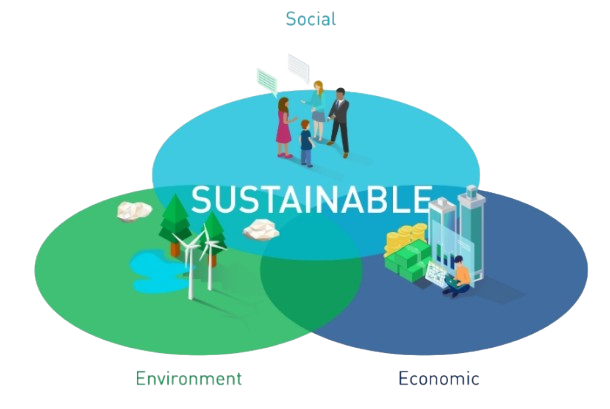
There is a whole vocabulary cluster surrounding “net zero”: “sustainability”, “carbon neutrality”, “the green transition”, “responsible development”. These terms share a structural feature. They are defined by what they claim to pursue rather than by what they require of anyone.
“Sustainability” is the oldest and most resilient example. The term entered mainstream policy discourse through the Brundtland Commission report Our Common Future (1987), which defined sustainable development as development that “meets the needs of the present without compromising the ability of future generations to meet their own needs” (World Commission on Environment and Development, 1987, p. 43). The definition has been cited in almost every subsequent policy document on the subject. It is also nearly impossible to operationalise. Who determines present needs, and who speaks for future generations, are questions the phrase does not answer.
Stibbe (2015) argues that such terms function as “stories we live by”: cognitive frames that make certain questions thinkable and others invisible. When the dominant frame is “the green transition”, the available questions concern pace and method. The question of whether continued economic growth is compatible with adequate carbon reduction is excluded by the frame before any debate begins.
What the grammar permits
The language of climate policy is not dishonest in any simple sense. Governments do intend to pursue emissions reductions. IPCC scientists are genuinely alarmed by their own findings. The question CDA asks is not whether speakers are sincere but what their language permits and what it closes off.
“Net zero by 2050” permits continued fossil fuel extraction if the carbon accounting supports it. “The transition” removes the question of who bears the cost and who decides. “Should” and “can” dilute what might otherwise be enforceable obligation. “Sustainability” accommodates almost any position if the metric is chosen carefully. Taken together, these choices do not describe inaction. They make inaction sound responsible.
I am not trying to demonstrate that there is a conspiracy. My aim is to engage with the language, with textual evidence, and show how the grammar of climate commitment can make certain obligations easy to announce as well as making them nearly impossible to enforce.
This article connects to an earlier piece on Halliday's systemic functional linguistics. The next article applies the same analytical lens to press coverage of protest: who gets assigned agency, who gets assigned violence, and how that attribution is built into the grammar of the news report.

©Antoine Decressac — 2026
Halliday, M.A.K. and Matthiessen, C.M.I.M. (2004) An Introduction to Functional Grammar. 3rd edn. London: Arnold.
Stibbe, A. (2015) Ecolinguistics: Language, Ecology and the Stories We Live By. London: Routledge.
Carvalho, A. (2007) ‘Ideological cultures and media discourses on scientific knowledge: re-reading news on climate change’. Public Understanding of Science, 16(2), pp. 223–243.
IPCC (2022) Climate Change 2022: Mitigation of Climate Change. Summary for Policymakers. Geneva: IPCC.
World Commission on Environment and Development (1987) Our Common Future. Oxford: Oxford University Press.
Fairclough, N. (2001) Language and Power. 2nd edn. London: Longman.
this is why CDA is so important -- to show what lies behind the framing and the grammar
Greta Thunberg is more sincere, and radical. She talks about "Real Zero". ( Not that I agree with her)