
Applications and Complexities of Phrase Structures
The Linguistics of Phrase Structures - Part 3


This is the third and final part of my exploration into the fascinating world of phrase structures. In Part 1, I laid the groundwork by introducing the basic concepts of phrase structures, exploring how words and phrases are organised hierarchically within sentences. I discussed the essential building blocks, such as noun phrases, verb phrases, adjective phrases, and prepositional phrases, and illustrated these concepts with clear examples.
In Part 2, I went deeper into the rules governing phrase structures, examining the head rule, complement rule, specifier rule, and adjunct rule. These rules provided a framework for understanding how phrases are constructed and how they function within sentences. I also explored transformations and movement, showing how elements within a phrase structure can shift to convey different meanings and emphasise various components.
Now, in Part 3, I want to explore the broader applications of phrase structures in linguistics. I’ll examine how phrase structures contribute to syntax, semantics, and pragmatics, and discuss their role in language acquisition and teaching. Additionally, I’ll tackle the challenges and complexities that arise from phrase structures, including ambiguities, exceptions, and cross-linguistic variations.
By the end of this part, I hope to have given a comprehensive understanding of phrase structures and their significance in linguistics.
Applications in Linguistics
Understanding phrase structures and the rules that govern them is not just an academic exercise; it has practical applications across various fields of linguistics. Phrase structures contribute to syntax, semantics, and pragmatics, and are essential for a comprehensive understanding of language.
Syntax.
Phrase structures are fundamental to syntactic analysis, which is the study of how words combine to form grammatical sentences. By analysing phrase structures, linguists can uncover the underlying rules that govern sentence formation and identify the grammatical relationships between words and phrases.
Sentence Parsing: Phrase structure trees help linguists parse sentences, breaking them down into their constituent parts and illustrating the hierarchical relationships between them. For instance, the sentence “The big black dog chased the small white cat under the table” can be parsed into noun phrases (NP), verb phrases (VP), adjective phrases (AP), and prepositional phrases (PP), as I discussed earlier in part 2.
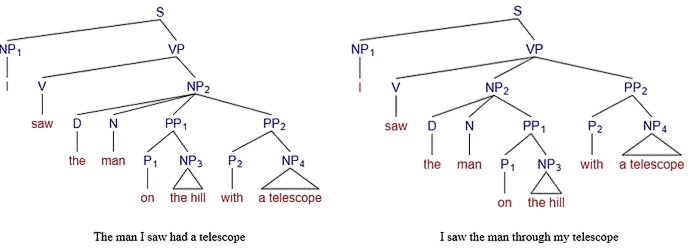
Ambiguity Resolution: Phrase structures can help resolve ambiguities in sentences. Consider the sentence “I saw the man on the hill with a telescope.” The phrase structure tree can reveal two possible interpretations: one where “with a telescope” modifies “the man” (the man has a telescope), and another where it modifies “saw” (I used a telescope to see the man).
2. Semantics.
Phrase structures also play a crucial role in semantics, the study of meaning in language. The hierarchical organisation of phrases influences how we interpret the semantic roles of different elements in a sentence, such as agents, patients, and instruments.
Thematic Roles: Phrase structures help us identify thematic roles, which are the roles played by different participants in an event described by a sentence. For example, in the sentence “The big black dog chased the small white cat,” the noun phrase “the big black dog” is the agent (the one doing the chasing), and “the small white cat” is the patient (the one being chased).
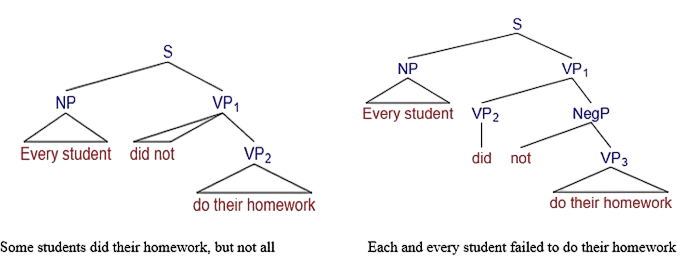
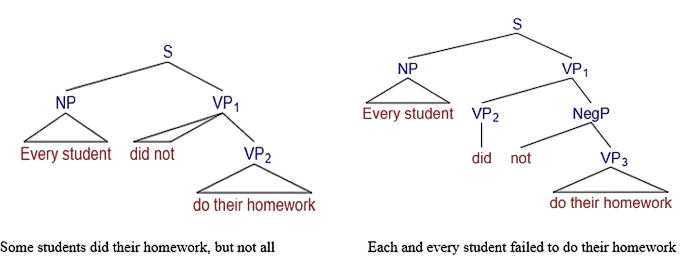
Scope Ambiguity: Phrase structures can also help resolve scope ambiguities, which occur when the scope of certain elements, such as quantifiers or negations, is unclear. For instance, in the sentence “Every student didn’t do their homework,” the phrase structure tree can show whether “every student” is within the scope of “didn’t” (meaning no student did their homework) or outside of it (meaning not every student did their homework).
Syntactic Tree: semantic ambiguity 3. Pragmatics.
In pragmatics, the study of how context contributes to meaning, phrase structures can influence the contextual interpretation of language. The way phrases are organised can affect how we understand nuances, implications, and emphasis in communication.
Focus and Emphasis: Phrase structures can highlight certain elements in a sentence, drawing the listener’s or reader’s attention to them. For example, in the sentence “It was the big black dog that chased the small white cat” (as opposed to some other animal), the phrase structure emphasises “the big black dog” as the focus of the sentence.
Implicatures (see my article of this topic): Phrase structures can also generate implicatures, which are implied meanings that go beyond the literal meaning of a sentence. For instance, the sentence “If you can pass the exam, you can go to the party” implies that passing the exam is a condition for going to the party, and the phrase structure helps convey this implicature.
4. Language Acquisition and Teaching.
Role: Understanding phrase structures is essential for language acquisition and teaching. Knowing how phrases are organised and how they function within sentences can help language learners grasp the underlying rules of a language and improve their communication skills.
Grammar Instruction: Teaching phrase structures can help students understand the grammatical rules of a language and apply them in their speaking and writing. For instance, learning about noun phrases, verb phrases, prepositional phrases, and their nesting hierarchical structure, can help students construct more complex and accurate sentences.
Error Analysis: Analysing phrase structures can also help identify and correct errors in language use. For example, a teacher can use phrase structure trees to pinpoint where a student has made a grammatical error and explain how to correct it.
Phrase structures are a vital component of linguistics, contributing to our understanding of syntax, semantics, pragmatics, and language acquisition. In the next section, I’ll discuss the challenges and complexities that arise from phrase structures, including ambiguities, exceptions, and cross-linguistic variations.
Challenges and Complexities
While phrase structures provide a robust framework for understanding language, they also present various challenges and complexities. These intricacies underscore the richness and diversity of human language, as well as the need for nuanced analysis. Let’s get into some of the key challenges and complexities that arise from phrase structures.
Ambiguity.
One of the most significant challenges in phrase structure analysis is structural ambiguity. Structural ambiguity occurs when a sentence can have more than one possible interpretation due to its structure. This can lead to confusion and miscommunication if not properly understood.
I have already shown this earlier with “I saw the man on a hill with a telescope”. Another example of structural ambiguity could be ”The chicken is ready to eat”.
Exceptions.
Language is full of exceptions that do not follow the standard rules of phrase structures. These exceptions can make analysis more complex and require a deeper understanding of the specific context and conventions of the language.
Idioms: they are fixed expressions that have a meaning different from the literal meaning of the words. For example, the phrase “break a leg” means to wish someone good luck, but its phrase structure does not reflect this meaning. Analysing idioms requires knowledge of their idiomatic meanings rather than their literal structures. That’s when language and culture meet.
Ellipsis.
Ellipsis is the omission of words that are understood from the context. While ellipsis is common in natural language, it can complicate phrase structure analysis by creating incomplete or implied structures.
Gapping: in the sentence “John likes coffee, and Mary __ tea,” the verb “likes” is omitted in the second clause but is understood from the context. The phrase structure must account for this implied verb to maintain coherence.
Stripping: in the sentence “John can play the piano, but not Mary __,” the verb phrase “can play the piano” is omitted in the second clause but is understood from the context. The phrase structure must reflect this omission to convey the intended meaning.
Discontinuous Constituents.
Discontinuous constituents are elements of a phrase that are not adjacent to each other in the sentence. This discontinuity can complicate phrase structure analysis by requiring the identification of non-contiguous elements.
Topicalisation: In the sentence “This book, I have read many times,” the object “this book” is moved to the front of the sentence, creating a discontinuous constituent. The phrase structure must account for this movement to maintain coherence.
Extraposition: In the sentence “It is obvious that John will pass the exam,” the subject “that John will pass the exam” is moved to the end of the sentence, creating a discontinuous constituent. The phrase structure must reflect this movement to convey the intended meaning.
These are a few of the challenges and complexities to understanding phrase structure. Morphology or cross linguistics variations are added layers of complexity.
By understanding these challenges and complexities, we can appreciate the intricate nature of phrase structures and the need for nuanced analysis. These intricacies highlight the richness and diversity of human language, as well as the importance of context and convention in linguistic analysis.
In the final section, we’ll conclude our exploration of phrase structures, recapping the key points and emphasising the significance of this foundational concept in linguistics.
Throughout this series, I have explored the intricate world of phrase structures, showing the rules and principles that govern how words and phrases are organised within sentences.
Importance
Understanding phrase structures is crucial for anyone interested in linguistics, language acquisition, and effective communication. Phrase structures provide a foundation for analysing and interpreting the complex movement of words and phrases that underpins our language. By mastering these concepts, we can:
Enhance Language Learning: Grasp the underlying rules of a language and improve communication skills.
Improve Grammar Instruction: Teach the grammatical rules of a language and help students construct more complex and accurate sentences.
Resolve Ambiguities: Identify and resolve ambiguities in sentences, ensuring clear and effective communication.
Analyse Language Use: Identify and correct errors in language use, enhancing the accuracy and coherence of communication.
I hope I have laid a solid foundation to phrase structures, but there is always more to discover in the world of linguistics. For those eager to delve deeper, stay with me as I will also tackle other areas of linguisitics.
Transformational Grammar: Investigate the rules and principles of transformational grammar, which describe how sentences can be transformed to convey different meanings.
Generative Linguistics: Study the theory of generative linguistics, which aims to describe the underlying rules that govern human language.
Cross-Linguistic Studies: Explore how phrase structures vary across different languages and the unique grammatical rules and conventions of each language.
Psycholinguistics: Investigate how the mind processes and understands language, including the role of phrase structures in language comprehension and production.
Thank you for reading my articles on the world of phrase structures.
©Antoine Decressac — 2025.
As an Amazon Associate, I earn from qualifying purchases.
Here are a few good books I would recommend:
How Language Works. David Crystal (2007): It provides an accessible yet comprehensive overview of how language develops, including phrase stucture. His engaging writing style and knack for simplifying complex concepts make it ideal for non-specialists. The book balances academic insight with practical examples, making it both informative and enjoyable to read.
An Introduction to English Sentence Structure. Andrew Radford (2020): This book provides a clear and concise overview of English syntax, focusing on sentence structure. Radford explains complex concepts in an accessible manner, making it suitable for readers without a background in linguistics.
A Student’s Introduction to English Grammar. Rodney Huddleston (2021): his updated edition offers a thorough introduction to English grammar, emphasizing phrase structure and syntactic analysis. The authors present material in an engaging and straightforward style.
Thank you for this short series, which was pitched at about the right level for me: at the time and place where I should have been learning these topics, the education board had been persuaded that it was unnecessary, as we could pick up what we needed from reading great literature (I'm just about certain that this theory was invented and promulgated by English teachers, who likely prefer talking about literature over grinding through grammar exercises.)
There is, however, one example here that I have utterly failed to grasp: I just cannot see how “Every student didn’t do their homework” could be construed as saying "some students did their homework, but not all," even with reference to the corresponding syntactic tree. The issue I'm hung up on is that, even in that parsing, the "not" is not negating the "every student" clause, so the claim seems to apply to every one of them. I think this can be seen more clearly if we substitute a list of the names of all of the students for "every student": if, for example, we substitute "Jack and Jill" there, we get a sentence which, while not as explicit as "neither Jack nor Jill did their homework", seems to point pretty strongly in that direction. Is there anything you could add to help me see the "some, but not all" reading?
Update: to add some specificity to "point pretty strongly in that direction:" I do not see how the sentence could be read as an affirmation that someone did complete their homework: at best, it does not completely foreclose on the possibility.